
Automated Vision Inspection Systems in Food, Beverage, and Pharmaceutical Production Lines
Production lines in the food, beverage, and pharmaceutical industries operate at increasingly high speeds while handling a wide variety of products, packaging formats, and filling configurations. At the same time, market requirements continue to become more demanding, with expectations for full traceability, product consistency, packaging integrity, and accurate documentation of any deviation throughout the manufacturing process. In this environment, quality inspection has become an integral part of production operations. It is no longer a secondary process performed at selected intervals during the day, but a continuous mechanism designed to inspect every individual product in real time.
Based on our experience at ASIO Vision, manufacturers typically transition to automated quality inspection when they seek to improve process stability, reduce rejects, and ensure consistent product quality even at high production speeds.
Multiple Inspection Points Throughout the Production Process
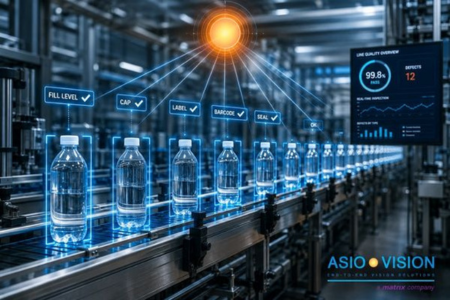
One of the primary challenges in filling and packaging lines is the large number of inspection points required throughout the manufacturing process. At the container stage alone, manufacturers may need to verify container presence, packaging type, fill level, structural integrity, and, in some applications, detect foreign objects inside the container. Additional inspections include cap verification, tamper-evident ring inspection, label positioning, barcode verification, variable data printing, and finally, outer packaging inspection.
When these inspections are performed manually or through sampling methods only, maintaining consistent quality and full process control becomes increasingly difficult. On high-speed production lines, even minor deviations—such as a misaligned label, an incorrect fill level, or an improperly sealed container—can affect a large number of products within a very short period.
From Sampling Inspection to Continuous Real-Time Quality Control
Modern machine vision systems enable all of these inspections to be performed continuously, automatically, and at production-line speed. The system instantly classifies every individual product as either acceptable or rejected while maintaining complete inspection records for quality assurance, traceability, root cause analysis, and continuous process improvement.
One of the most significant advantages of these systems is their ability to identify trends and process deviations at an early stage. For example, a gradual change in fill level may indicate drift in a specific filling head. Repeated label positioning errors may signal that the labeling system requires recalibration. Recurring sealing defects may point to mechanical wear or changes in the operation of specific production equipment. In many cases, the accumulated inspection data enables production and maintenance teams to better understand line performance over time and make data-driven decisions in real time.
Machine Vision as an Operational Decision-Making Tool
This capability transforms a machine vision inspection system into much more than "a camera that inspects products." In practice, it becomes an industrial information system that integrates directly with the production process, providing continuous visibility into line performance, process stability, and overall product quality.
Successful implementation depends on adapting the inspection system to the specific production environment. Every manufacturing line presents unique characteristics, including product types, operating speeds, lighting conditions, packaging materials, marking technologies, and quality requirements. For this reason, advanced machine vision solutions are designed around each customer's specific application and configured according to the required sensitivity levels, defect types, and production workflows.
Tailored to the Production Line
At ASIO Vision, this approach guides every stage of implementation-from the initial feasibility assessment and inspection definition through full integration with the customer's production and control systems. Support for multiple product recipes, rapid product changeovers, and seamless integration with PLC and MES systems enables each solution to be precisely adapted to the specific requirements of the production line.
Our experience across dozens of industrial projects demonstrates that combining machine vision, continuous inspection, and real-time decision-making creates a more stable, accurate, and consistent manufacturing environment. As production lines continue to become faster and more diverse, automated quality inspection is increasingly becoming an integral component of the manufacturing process and a foundation for continuous quality and process improvement.